

Background
The labyrinth has come down through time as a metaphor for the journey. SPNSCC has been engaged in a very special journey since it was created in 1955. Those who laid the groundwork for this relationship were inspired and brave. In a postwar world left with terrible wounds on all sides, the forging of this first friendship of its kind was a big step toward healing. With the creation of the peace charter in 1989 came the commitment to “work for the realization of global harmony”, another step along the path. Many steps were taken in the years between.
Step by step, friendships between citizens across the world from each other have proven to be strong and true. As visitors travel back and forth, building on friendships and finding common ground, many hours are spent sharing each other’s families, friends, customs and cities. Visiting special sites marking our friendship is a significant part of this process and can be a valuable means of communication when language is a barrier. The people of Nagasaki have offered hospitality of the highest order to many of us through the years. Some of us have experienced in common the remarkable feeling of hope upon leaving the peace museum there to walk on a street named after St. Paul. The street is only one site in Nagasaki honoring our relationship but it is an important one. The naming of streets is highly symbolic, a public acknowledgment of a city’s commitment to an idea.
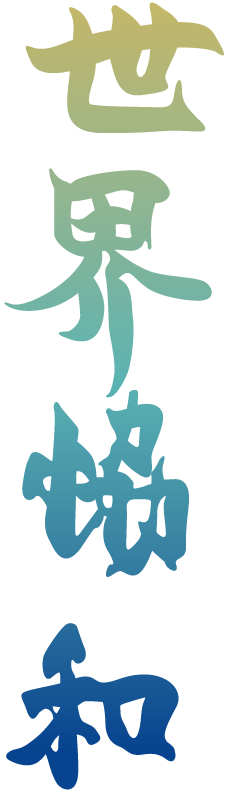
We had a street named for Nagasaki for some years but it is no longer. With its loss, the committee began to search for an idea and a location that would come together to create an experience of spirit of place for our guests from Nagasaki. Simultaneously the renewed interest in labyrinths came to the fore and the committee decided to pursue a labyrinth project. That piece of the journey has been labyrinthine itself. From the beginning of SPNSCC’s efforts to create a site commemorating our sister cities relationship, the intent was to do it in a way that emphasized the Peace Charter. The term “global harmony” is taken from that document. I was honored to be asked to design a Global Harmony symbol for our anniversary observance in 1995. The directive to me as an artist, was to design something that spoke to the uniqueness of the bond between two such different cultures, a symbol of peace. A second request soon followed to create a labyrinth based on that symbol. Global Harmony is a good theme for a labyrinth which itself can be a device to bring inner peace.
An original design was requested because the spirit of the project involved healing the pain from the bombing of Nagasaki. When gathering my thoughts about how to visually express the coming together of two cultures sharing such a complex history, yin yang came to mind immediately… followed by thoughts of physicist Niels Bohr’s concept of complementarity. Bohr’s life had an astonishing influence in the worlds of the atom and of peacemaking. The creation of the new labyrinth was thought to be important as a mark of our reaching out to another culture with differing history, religious traditions and life outlooks, a fresh gesture of abiding friendship, a blend of East – West sensibilities. Although Christianity has a remarkable history in Nagasaki, it is only one of several faiths embraced by the populace.
The Global Harmony design attempts to bridge all faiths. To describe its elements separately: The sphere represents the earth. The line expressing yin/yang represents the relationship of opposite elements, mutually essential to the wholeness of both. The hands represent human effort to maintain balance. For general graphic use, the logo or labyrinth sits at a tilt, on an axis like the world itself, to reflect equality between hemispheres. In this way one can envision the world turning so that no one hand Is ever always in a “top” position. There is no conscious effort to create numerical meanings as are found in many labyrinths. The messages here concern global friendship and peace.
In earliest histories, labyrinths are described as mythic prototypes of cities. This is a labyrinth to link two cities a world apart. This has resulted in a different manifestation than the type more familiar to those who first became acquainted with labyrinths bearing religious significance. This design has ‘open’ spaces. For those familiar with more dense conventional designs, the answer to the question “should it be filled in?” is that the spaces are by design. It is spiritual space. It is also a nod to asymmetry within symmetry which may make it friendlier to our Japanese friends, sensitive to another aesthetic. It offers openhandedness in homage to the theme of friendship. And then, for those who love the balance of positive and negative space, it does not have to be filled to be filled.
The other design elements that may remind you of Japan are often noticed as you are approaching the labyrinth. From the side, the lines are meant to remind you of raked zen gardens like Ryoanji, with its suggestions of water flowing around islands, or clouds around mountain peaks. Or the flowing lines of water in a stream as painted by Ogata Korin.
With an accompanying description of its meaning, perhaps more visitors will become interested in our Japanese – American connections, people who would not otherwise be exposed to our sister city history.
Through the years a number of sites and sizes have been considered and even thought to be resolved! We now have a site. It is located along the path from the conservatory to the lake pavilion in Como Park. There is a lovely view from the site looking over a much loved fountain to the lake. It is a peaceful spot but close enough to human activity to make it feel safe for individual use. One of our past board members, Bill Pesek, came up with several choices but this spot was enthusiastically agreed upon.
This site will also be dedicated to the memory of Karen Kunzman. A fine musician, she traveled to Nagasaki several times to perform. A Japanese friend said of her, “She has a Japanese heart.” A plaque at the labyrinth’s center will read “Global Harmony Labyrinth, Dedicated August 21st in recognition of the 50th Anniversary of the Saint Paul / Nagasaki Sister City relationship, in memory of Karen S. Kunzman. She had a Japanese Heart.”
Cynthia McKeen
With Grateful Appreciation to:
The Grotto Foundation
Louis Fors Hill, on behalf of the Hill Family, in honor of Louis W. Hill, founder of the Grotto Foundation and the Saint Paul-Nagasaki Sister City Committee
The Hubbard Broadcasting Foundation
Saint Paul Parks and Recreation Department
All the volunteers who have given so generously of their time and energy
© CM 1992